Migrations
Off Teradata, Oracle, or Hadoop. Onto a data practice the team keeps.
A migration is won in the planning, the parity checks, and the cutover no one notices, not in the license swap. We run that whole arc as one accountable team: code converted automatically, every number validated against the source, and the business running the entire way.
Every source platform
We migrate from all of them
Legacy appliances, cloud warehouses, Hadoop, or the database quietly doing warehouse duty. If the data lives there today, we have a path to land it on Snowflake, governed and in the team's hands: automated conversion where Snowflake AIM covers the source, hand-built where it doesn't.
Legacy MPP & data warehouses
- Teradata
- IBM Netezza
- Oracle Exadata
- SAP BW / BW4HANA
Cloud data warehouses
- Amazon Redshift
- Google BigQuery
- Azure Synapse
- Databricks
Hadoop & data lakes
- Cloudera / Hortonworks
- Apache Hive
- Apache Spark
- HDFS
Databases doing warehouse duty
- Oracle Database
- Microsoft SQL Server
- IBM Db2
- PostgreSQL
- MySQL
Legacy ETL & analytics
- Informatica
- Talend
Platform names and logos are trademarks of their respective owners, shown to indicate migration sources we support. On something not listed here? We have almost certainly seen it. Tell us what’s running and we’ll map the path.
Why teams move
The case for leaving legacy behind
The platform changes, but the reasons rhyme: cost, operational burden, and a foundation that is finally ready for AI.
Today
- Licenses keep rising. Teradata, Netezza, Exadata, and SAP BW carry end-of-life clocks and support bills that only go up.
- Infrastructure to babysit. Appliances to patch, clusters to tune, capacity bought a year ahead and idle half the time.
- Analytics that crawl. Row-based engines and overloaded clusters turn every dashboard into an overnight batch.
On Snowflake
- Cost that flexes with use. Compute by the second, scaled independently from storage. No idle clusters.
- One governed foundation. One source of truth with access, lineage, and policy built in through Horizon, so decisions run on numbers people trust.
- AI is the next step. Cortex and the leading models run next to the governed data, so the first AI use cases ship from the same foundation, not another project.
How we migrate
Automated, validated, and phased
A Snowflake migration covers the whole data estate: every table, view, stored procedure, and downstream report is inventoried, converted, validated against the source, and cut over by business unit before the legacy system is retired. A repeatable arc that de-risks the move. Most of the conversion is automated; the cutover never is.
Assess & plan
Convert
Migrate & validate
Parallel run & cutover
Optimize & decommission
a scoped 8–16 week arc
Assess & plan: We inventory every table, view, stored procedure, and downstream report, map the dependencies, and build the business case before anything moves.
Convert: The bulk of the SQL, stored procedures, and scripts convert automatically; our engineers remediate the edge cases by hand and review every object before it moves on.
Migrate & validate: Historical loads plus incremental CDC through Openflow and Snowpipe keep data current, while automated row, aggregate, and hash checks prove parity against the source.
Parallel run & cutover: Both systems run side by side with nightly reconciliation. We cut over in phases by business unit, never a big-bang switch, and only once the numbers match.
Optimize & decommission: We tune warehouses and pipelines on real usage, retire the legacy system, and ship the documentation and runbooks. From there the team runs it, or Viewnear keeps tuning and running it as a managed service.
Our conviction
The tools convert the code. They don't answer for the month-end close.
Snowflake AIM does the typing where it covers the source: the SQL, stored procedures, and Spark jobs that took years to write convert in weeks. What we're actually hired for is everything the tools can't sign off on: the edge cases remediated by hand, every object reviewed before it moves on, and row, aggregate, and hash reconciliation proving the new numbers match the old ones before anyone cuts over.
- Conversion output reviewed object by object, in Snowflake Workspaces
- Row, aggregate, and hash checks prove parity against the source
- A parallel run with nightly reconciliation before any cutover
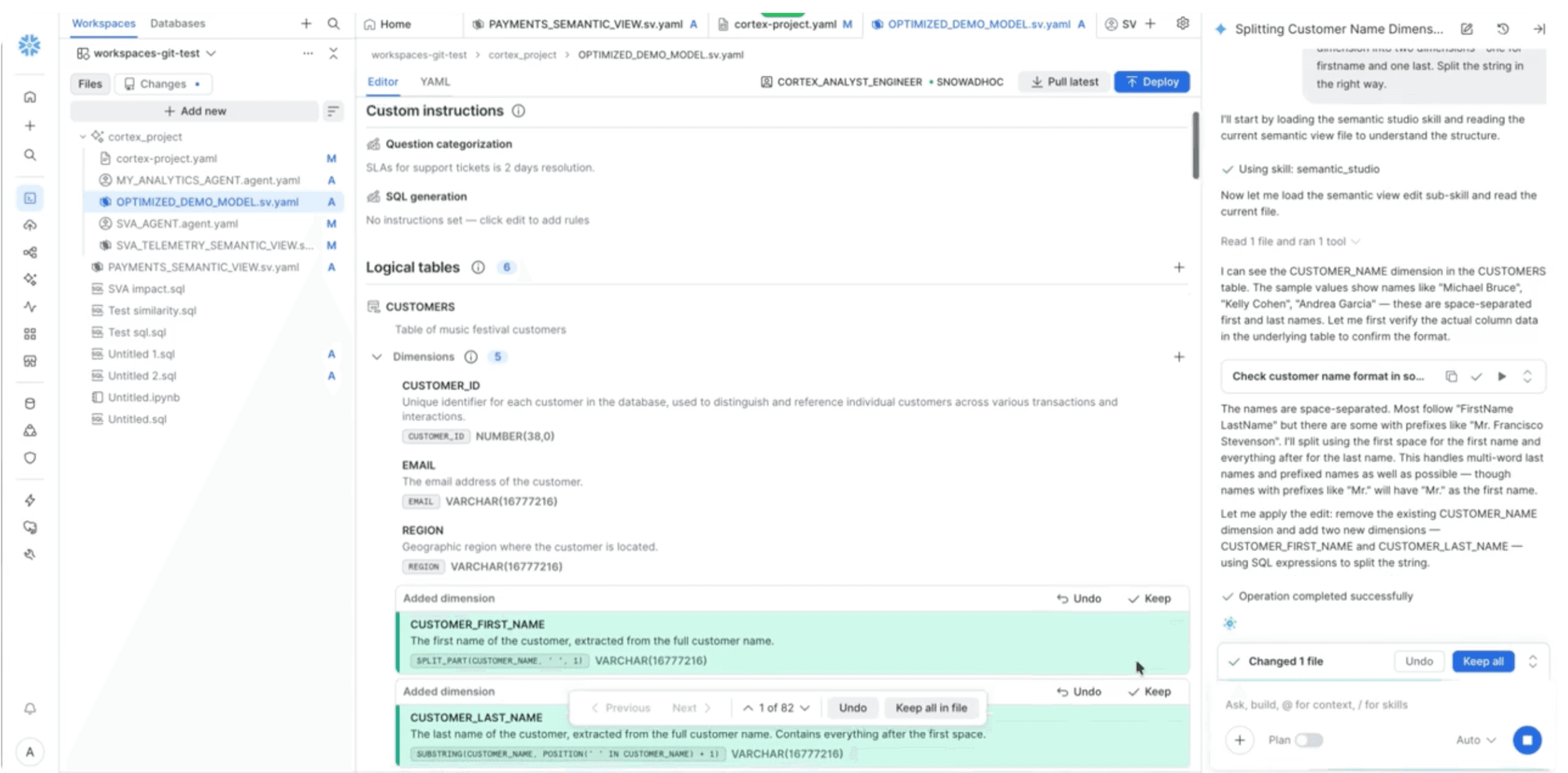
Live example: real-time student data across campuses, live in seven weeks →
The hard parts, handled
The legacy logic comes too
Migrations stall on the procedural code and pipelines, not the tables. Here is what we carry over for the platforms we see most.
Teradata
BTEQ, FastLoad, and MultiLoad scripts, macros, and stored procedures converted; primary-index logic redesigned as clustering.
Oracle
PL/SQL packages, triggers, and cursors translated to Snowflake Scripting; constraints moved into validated pipelines.
SQL Server
T-SQL and SSIS packages converted to Snowflake SQL and dbt models on a native scheduler.
Hadoop, Hive & Spark
Hive SQL and PySpark or Scala jobs moved to Snowflake SQL and Snowpark; Parquet landed as Iceberg.
Redshift & BigQuery
Dialect differences and DISTKEY, SORTKEY, or partition logic translated; cost re-modeled for elastic compute.
Netezza & Vertica
Appliance-specific SQL and procedures converted off end-of-life hardware onto elastic Snowflake.
Backed by Snowflake
A certified team that has done this before
Migrations run on Snowflake's own tooling, delivered by SnowPro-certified engineers with a verified track record across the USA and LATAM.



See migrations in production in our case studies →
A migration is usually one part of a wider implementation.
Consulting & implementation→Rather just ask someone?
Book 30 minutes with the person who would own the work. No deck, no obligation, and a straight answer on whether we are the right fit.