AI Analytics on Snowflake
Put governed AI to work: Cortex Analyst, Cortex Agents and Snowflake CoWork turn governed data into cited answers, and into the next action.
Put answers in the hands of the people making decisions. We build self-service analytics and AI agents on Snowflake: Snowsight dashboards and Streamlit apps for the views teams live in, Cortex Analyst answering plain-language questions over governed Semantic Views, and Snowflake CoWork letting business users explore and act. This is the business intelligence layer rebuilt so a question returns an answer instead of a ticket: no waiting on the data team, no exporting to spreadsheets.
What we deliver
What we deliver: self-service analytics on Snowflake
Every engagement builds the layer where the business actually meets its data, natively on Snowflake so governance travels with every answer:
Cortex Analyst implementation
Semantic Views that encode your metrics, joins, and business terms, so natural language questions return accurate, cited answers instead of guesses.
AI agents on Snowflake
Cortex Agents that plan across structured data and documents, with Cortex Search handling retrieval, running inside Snowflake next to the data.
Snowflake CoWork for business users
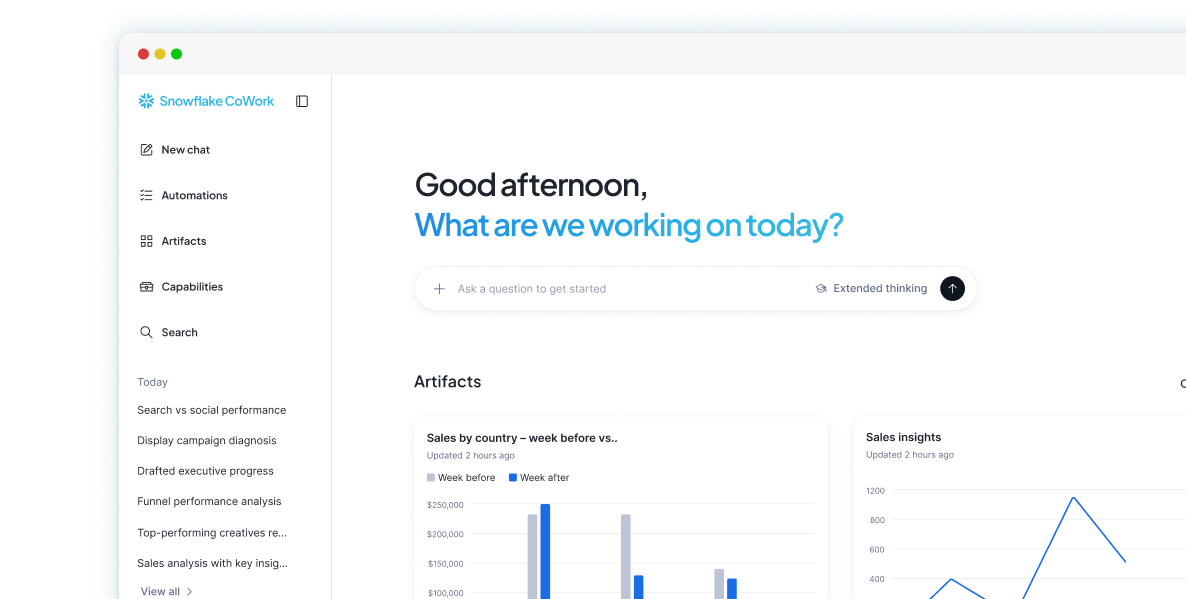
The personal AI agent, configured over your governed data so anyone can explore, ask follow-ups, and act in plain language.
Snowsight dashboards and Streamlit in Snowflake apps
The data visualization layer teams open every morning: curated views and interactive data apps, with nothing copied outside the governed perimeter.
Answers where work happens
Insight delivered into the workflows leaders already use; when analytics becomes part of your product, our embedded analytics service carries it into customer-facing apps.
In practice
What it looks like in your stack
A closer look at what we stand up and how it lands where your team already works.
- Cortex Analyst implementation
- AI agents on Snowflake
- Snowflake CoWork for business users
How we work
How an analytics rollout runs
A fixed cadence that puts working software in front of you fast and makes each decision on evidence, not a deck.
- 01
Discovery
A short, focused engagement that fixes scope and surfaces the real state of your data.
- 02
Use-case sprints
Working increments ship into your environment, one decision-ready slice at a time.
- 03
Proof before scale
Each slice proves out in production before anyone commits to the next.
- 04
A practice you keep
Your team builds alongside ours, so the capability stays in-house, with Viewnear available to run and improve it as a managed service.
Self-service analytics is only as good as the data underneath it. When pipelines need hardening first, our data engineering team gets the inputs decision-grade; from there the work moves into the analytics and agent layer.
First value lands in 8–16 weeks, and the mechanism is what makes that number honest: a discovery fixes scope, use-case sprints ship one governed answer set at a time, and scaling decisions rest on proof, not a slide. Many AI-agent projects on Snowflake stall between demo and production; the sprint model exists to close exactly that gap, with pricing tied to outcomes rather than hours.
Agents inside Snowflake are half the story. How they connect with agents working outside it, over one governed context, is laid out in our data & AI approach.
What engagements deliver
Nearshore delivery
A nearshore team in your review sessions
Monterrey, MX · Austin, TX · US time zones
Analytics and agent tuning is feedback-heavy work. A semantic model gets good the way a forecast does: someone asks a question, the answer comes back slightly off, an analyst explains why, and the definition is corrected. That loop breaks when the delivery team wakes up as yours logs off.
Our engineers work from Monterrey and Austin, on your hours. Nearshore AI development from Latin America usually means an outsourcing handoff; this model is the opposite. SnowPro-certified engineers sit in the same review sessions as your analysts, hear objections firsthand, and turn them into sharper Semantic Views and better-behaved agents in days, not release cycles. The full delivery model is on our nearshore page.
And the practice is built to stay yours: your team learns the semantic model and the agent configurations as we build, so the dashboards and agents keep improving, whether the team runs them or Viewnear does as a managed service. See how that plays out in our case studies.
FAQ
Questions teams ask before rolling out AI analytics
How accurate is Cortex Analyst?
As accurate as its semantic model. Cortex Analyst answers only through the Semantic Views it is given, shows the query behind every answer, and asks for clarification rather than guessing when a question falls outside them. Most of our implementation effort goes exactly there: verified queries, business-term coverage, and review cycles with your analysts until the answers hold up.
Do I need a semantic model for Cortex Analyst?
Yes. Text-to-SQL over raw schemas has to guess what "revenue" or "active customer" means, and guessing is what erodes trust. Semantic Views encode those definitions once, and Cortex Analyst, Cortex Agents, and Snowflake CoWork all answer through them. We build the first version during discovery and refine it with your team every sprint.
What is the difference between Cortex Analyst and Snowflake CoWork?
Cortex Analyst is the service that turns a natural language question into governed SQL, built to be embedded in apps and workflows. Snowflake CoWork is the agent experience business users open directly to explore data and act on it. Most engagements deliver both: CoWork for people, Cortex Analyst wherever answers need to surface inside a product or process.
Can Power BI and Tableau keep running after a move to Snowflake?
Power BI and Tableau keep running after a move to Snowflake, with Snowflake as the governed source they query. Security is implemented once in Snowflake, with row-level policies and secure views, so every BI tool inherits the same governance instead of enforcing its own, and data access stays auditable across all of them. New analytics work is built Snowflake-native: Snowsight dashboards, Streamlit in Snowflake apps, and Cortex Analyst answering plain-language questions over governed Semantic Views that encode metrics, joins, and business terms once.
What is the right way to connect Power BI or Tableau to Snowflake?
Power BI and Tableau should connect to Snowflake through the native Snowflake connector rather than a generic ODBC driver, so calculations push down to Snowflake instead of pulling data out to be processed elsewhere. Four patterns keep that connection fast and predictable: a service account with key pair authentication rather than individual user credentials, a dedicated warehouse per tool for predictable performance and clear cost attribution, aggressive auto-suspend with multi-cluster auto-scaling to absorb concurrent users without inflating cost, and live connections for large, changing data with extracts for smaller, stable data.

Proof
See it running in production
Real, anonymized engagements with measured outcomes, from a Snowflake Premier & Select Partner delivering nearshore across the USA and LATAM.
Explore the case studiesRather just ask someone?
Book 30 minutes with the person who would own the work. No deck, no obligation, and a straight answer on whether we are the right fit.



Where this leads
All 6 services