Data Engineering & Pipelines
Always-current, trusted data: governed pipelines that unify every source, so analytics and AI run on inputs worth staking decisions on.
No more chasing numbers across systems. Our Snowflake data engineering services deliver automated, governed pipelines that pull every source (ERP, CRM, SaaS, APIs, databases, flat files) into Snowflake reliably and on schedule, so teams work from data they can trust and AI workloads run on clean, current inputs. Built by a nearshore team in US time zones, priced to a defined outcome rather than the hours.
What we deliver
What our Snowflake data engineering services deliver
Every pipeline we build exists to feed a decision, a report, or an AI use case someone is waiting on. The typical scope includes:
ELT pipeline development
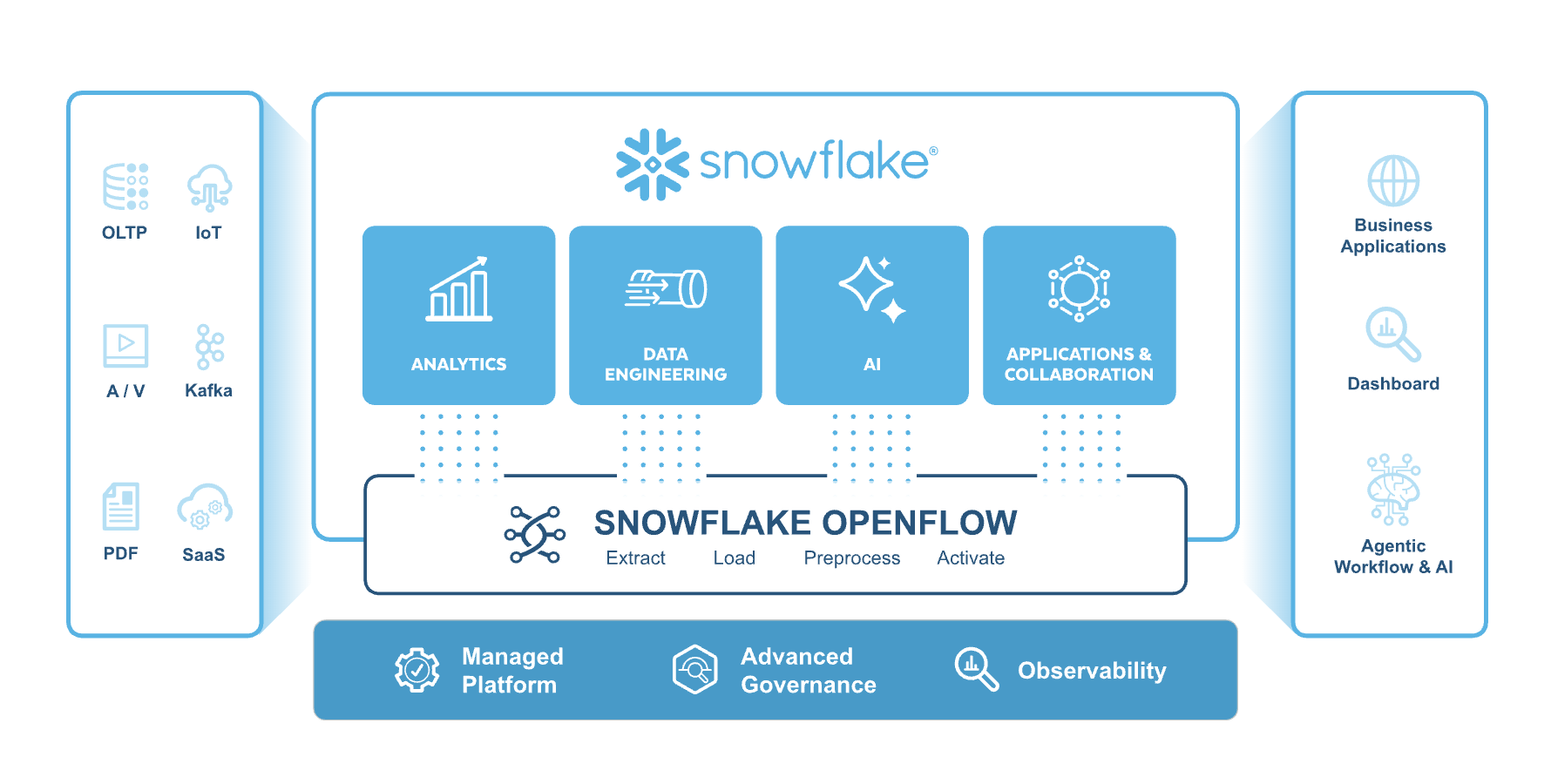
Ingestion with Openflow, Snowpipe Streaming for real-time feeds, and Zero-Copy Integrations where a SaaS source never needed a pipeline in the first place. Batch and streaming, one governed pattern.
dbt transformation layers
Business logic modeled in dbt: tested, versioned, documented, and reviewed like the production code it is, with Dynamic Tables handling incremental processing where it saves compute.
ETL modernization
Legacy jobs, stored procedures, and brittle scripts rebuilt as maintainable ELT, often as part of a broader migration to Snowflake.
Governance and data quality built in
Access policies and lineage in Horizon Catalog, quality tests that run inside the pipeline, and alerting that catches failures before the business does.
Open formats where they earn their place
Apache Iceberg tables and Open Catalog (Polaris) when interoperability across engines matters to your architecture.
Reliability and run cost are deliverables too, not side effects. Pipelines ship with tests, alerting and lineage from the first table, and warehouse sizing and scheduling are tuned as part of the build rather than after the first invoice.
In practice
What it looks like in your stack
A closer look at what we stand up and how it lands where your team already works.
- ELT pipeline development
- dbt transformation layers
- ETL modernization
How we work
How a pipeline build runs
A fixed cadence that puts working software in front of you fast and makes each decision on evidence, not a deck.
- 01
Discovery
A short, focused engagement that fixes scope and surfaces the real state of your data.
- 02
Use-case sprints
Working increments ship into your environment, one decision-ready slice at a time.
- 03
Proof before scale
Each slice proves out in production before anyone commits to the next.
- 04
A practice you keep
Your team builds alongside ours, so the capability stays in-house, with Viewnear available to run and improve it as a managed service.
We start with a discovery that fixes scope: which sources, which data products, which decisions they feed. The work then runs as use-case sprints, each shipping a working pipeline into your environment, with proof before anything scales. First value lands in 8–16 weeks because that structure removes the usual drift, not because anyone is rushing.
The pipelines land on a governed data foundation and feed everything downstream, from Snowsight reporting to the AI analytics layer built on Cortex. And because a defined build is priced to the outcome rather than the hours, there is no incentive to stretch the build.
What engagements deliver
Nearshore delivery
Data engineering outsourcing, without the handoff
Monterrey, MX · Austin, TX · US time zones
Teams that look into data engineering outsourcing usually want the same thing: reliable pipeline capacity without a months-long hiring cycle. What they fear is the classic version of it: requirements handed off into silence, code coming back weeks later, every question waiting overnight for another continent.
Our nearshore data engineering model is built to be the opposite. SnowPro-certified engineers work from Monterrey, Mexico and Austin, Texas, in US time zones, serving organizations across the USA and LATAM, with the depth of Latin America's data engineering talent. They work inside your repos, your CI, and your standards; sprint reviews happen inside your working day; and your engineers build alongside ours from the first sprint, because the goal is a data practice your team keeps, not a dependency on ours. That difference shows in how our nearshore delivery works and in the case studies behind it.
FAQ
Frequently asked questions
Should we use ETL or ELT with Snowflake?
ELT. Land raw data in Snowflake first, then transform it in-warehouse with dbt and Dynamic Tables. You keep full lineage from raw data to reporting, reprocessing becomes a rerun instead of a re-extract, and transformations scale on Snowflake compute instead of a separate ETL server.
Is it safe to outsource data engineering?
It is when the work never leaves your environment. Our engineers build inside your Snowflake account and your repositories, under access you grant and can revoke, with lineage and policies governed in Horizon Catalog. Everything inherits Snowflake's independently audited controls, and nothing about the model requires data to be copied out.
How fast does a nearshore data engineering team deliver value?
The first advantage is onboarding: the team already works your hours, so no ramp-up is lost to time zones and the hiring lead time disappears. From there the sprint mechanism takes over: a discovery fixes scope up front, use-case sprints ship working pipelines from the first weeks, and proof comes before scale, so first value lands in 8–16 weeks.
Proof
See it running in production
Real, anonymized engagements with measured outcomes, from a Snowflake Premier & Select Partner delivering nearshore across the USA and LATAM.
Explore the case studiesRather just ask someone?
Book 30 minutes with the person who would own the work. No deck, no obligation, and a straight answer on whether we are the right fit.



Where this leads
All 6 services