Cloud Architecture & Data Foundation
The AI-ready foundation: governed, built on Snowflake, and ready to scale, the single source of truth every model and agent depends on.
Every team gets one fast, scalable foundation to build on. We design and deliver a governed Snowflake data foundation, with cloud architecture sized for the AI workloads on the horizon, not just the reporting teams run today, and security and governance built in from the first table: the single source of truth every model, dashboard, and agent depends on.
What we deliver
What a governed Snowflake data foundation includes
Architecture is where cost, security, and trust get decided, usually years before anyone feels the consequences. We design with the decisions documented and build with your team, so the people who will run the foundation understand every layer. A typical build covers:
Cloud architecture design: account and environment topology, role-based access, and warehouses organized so Snowflake's consumption-based model stays predictable as workloads grow.
Ingestion built on Openflow, Snowpipe Streaming, and Zero-Copy Integrations, bringing ERP, CRM, and SaaS sources into one governed source of truth.
A tested transformation layer with dbt and Dynamic Tables, so every metric is versioned, reviewed, and reproducible.
Lakehouse architecture with Apache Iceberg and Open Catalog (Polaris) where open table formats are the right call, keeping storage open without giving up governance.
Governance from the first table: Horizon Catalog for lineage and access policy, and Semantic Views so business definitions live with the data, ready for Cortex when the AI use cases arrive.
A Snowflake architecture review for environments already running: we audit design, security, and spend, then leave a prioritized fix list your team can execute.
That discipline is what makes the first production use case land in 8 to 16 weeks rather than at the end of a programme, and what keeps each later use case cheaper than the one before it.
In practice
What it looks like in your stack
A closer look at what we stand up and how it lands where your team already works.
- Cloud architecture design
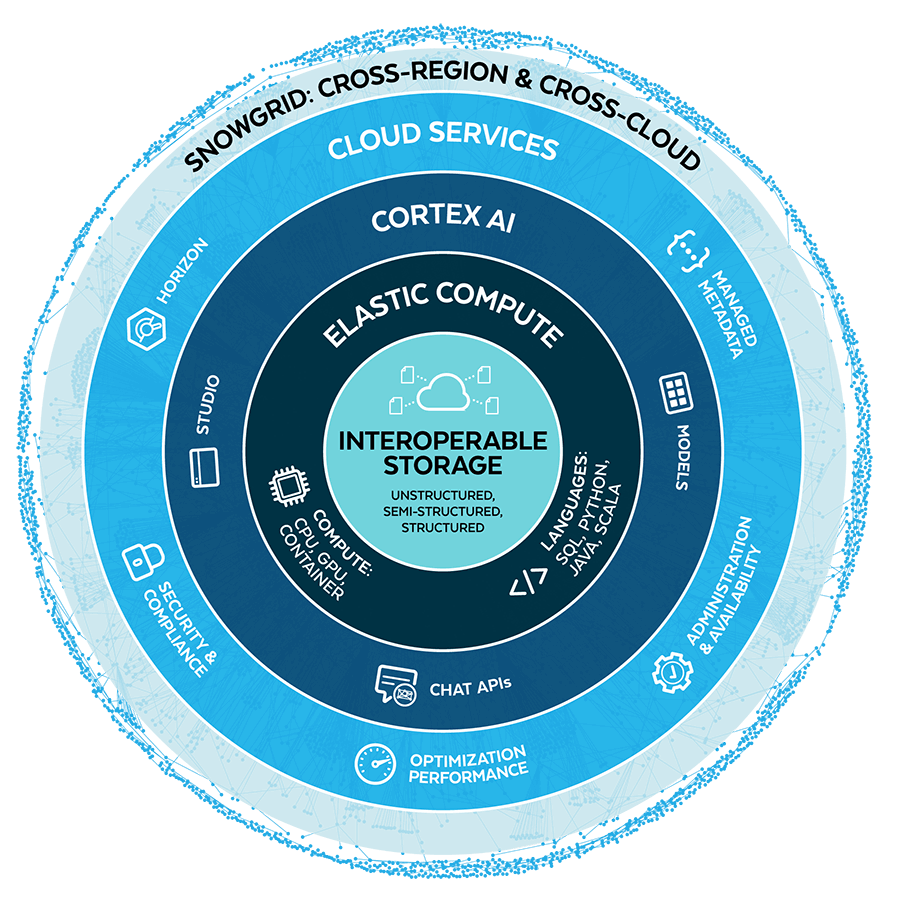
- Ingestion built on Openflow, Snowpipe Streaming, and Zero-Copy Integrations, bringing ERP, CRM, and SaaS sources into one governed source of truth
- A tested transformation layer with dbt and Dynamic Tables, so every metric is versioned, reviewed, and reproducible
How we work
How a foundation build runs
A fixed cadence that puts working software in front of you fast and makes each decision on evidence, not a deck.
- 01
Discovery
A short, focused engagement that fixes scope and surfaces the real state of your data.
- 02
Use-case sprints
Working increments ship into your environment, one decision-ready slice at a time.
- 03
Proof before scale
Each slice proves out in production before anyone commits to the next.
- 04
A practice you keep
Your team builds alongside ours, so the capability stays in-house, with Viewnear available to run and improve it as a managed service.
Choosing a Snowflake implementation partner is choosing the architecture you will live with for years, so we make the first step small and evidence-based. A short discovery fixes scope: sources, workloads, security requirements, and the first use cases the foundation must serve. Delivery then runs in use-case sprints, proving each slice in production before scaling it, which is how first value lands in 8–16 weeks instead of at the end of a long build, with pricing tied to outcomes rather than hours.
The Snowflake data foundation is never the finish line. It feeds the governed data pipelines that keep it current and the AI practice that puts Cortex analytics and agents to work on top of it. And when a legacy warehouse is in the way, migration to Snowflake is usually the first sprint, not a separate project.
What engagements deliver
Nearshore delivery
Nearshore architecture depth, on your hours
Monterrey, MX · Austin, TX · US time zones
Foundation work fails quietly when the architects and your platform and security teams are half a world apart: a design decision that waits overnight turns into days of rework. Our delivery hub in Monterrey, Mexico works US business hours, with leadership in Austin, Texas, serving clients across the USA and LATAM, so architecture reviews, security sign-offs, and scope decisions happen the same day they come up.
Nearshore does not mean the work disappears into a delivery queue. We work inside your team: SnowPro-certified engineers pair daily with your infrastructure and security people, senior judgment lands on the hardest architecture decisions, and your team keeps control of scope and priorities. That is architecture depth at nearshore economics, from a Snowflake Premier Partner and Snowflake CoCo Preferred Partner.
FAQ
Frequently asked questions
How long does a Snowflake implementation take?
For a governed Snowflake data foundation, we put first value in production in 8–16 weeks. The mechanism matters more than the number: a discovery fixes scope up front, delivery runs in use-case sprints, and each slice proves out before it scales. A full estate takes longer, but no one waits until the end to see working data products.
What is a Snowflake architecture review?
A structured audit of an existing Snowflake environment: account topology, security and access design, cost drivers, and pipeline reliability, measured against how Snowflake is built to run. You get a prioritized findings list with the reasoning documented, so your team can act on it with us or on its own.
Should we build a Snowflake lakehouse with Apache Iceberg?
Iceberg makes sense when other engines need to read the same tables, when data volumes push toward open storage economics, or when open formats are organizational policy. Open Catalog (Polaris) keeps those tables governed either way. When workloads live end to end in Snowflake, native tables are often simpler; discovery is where we decide with evidence rather than defaults.
How is data governance enforced, not just documented?
Data governance on Snowflake is enforced as configuration on the data itself, not as a policy document. Role-based access is modeled to the organization so people see only the data they need, enforced in Snowflake rather than bolted on afterward, and sensitive data is classified and masked with tagging plus row and column policies from the first table built. Horizon Catalog carries lineage and access history, so every figure is traceable to its source and every access is logged for audit. All of it runs in the client's own Snowflake account, so no copies leave that perimeter.
How is a golden record built across multiple source systems?
A golden record is built in layers inside the client's own Snowflake account. Source data lands in Bronze, is cleaned and conformed in Silver, and resolves into governed Gold records, with master keys, matching and merge, survivorship rules, lineage, and audit designed in from the first table. All the modeling runs in dbt under Git, so every rule that decides which value survives is reviewed, tested, and traceable. For a commercial-vehicle dealer group, Openflow lands the ERP, dealer management system, and payroll and HR system on a nightly incremental schedule, producing one governed version of customer, vehicle, part, supplier, and employee, each traceable back to its source.
Do all master data domains have to be mastered at once?
Master data domains are mastered in sequence, so each one reaches a trusted golden record in turn rather than all at once. In the master data build for a commercial-vehicle dealer group, eight business domains, from aftersales and parts catalogs to finance and HR, are delivered as three releases across a twelve-month roadmap. dbt tests validate matching, survivorship, and conformance on every run, so a bad record is caught before it reaches Gold and each domain stays trustworthy after the release that created it.

Proof
See it running in production
Real, anonymized engagements with measured outcomes, from a Snowflake Premier & Select Partner delivering nearshore across the USA and LATAM.
Explore the case studiesRather just ask someone?
Book 30 minutes with the person who would own the work. No deck, no obligation, and a straight answer on whether we are the right fit.



Where this leads
All 6 services
- AI Analytics on Snowflake
- Cloud Architecture & Data Foundation
- Data Engineering & Pipelines
- Embedded Analytics
- Capability Development
- Data & AI Strategy