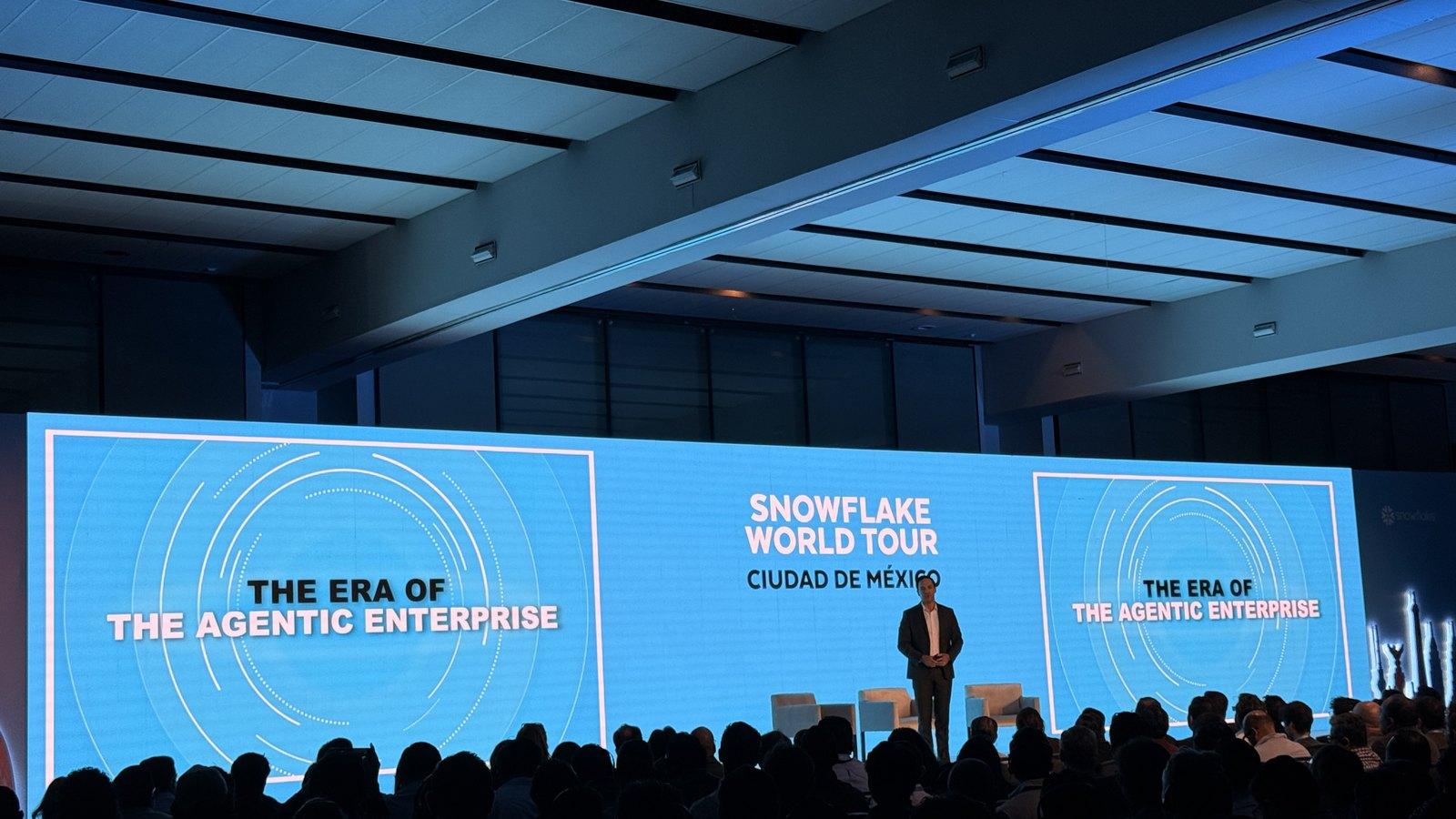

I watch every Snowflake keynote with the same question in mind: what does this change for the companies we work with?
For a long time the answer was about the technology. Faster queries. Cheaper storage. Data sharing. Then models, then agents. Every year the list of things the software could do got a little longer.
Expedition 2026 was the first time I came away thinking the most important announcements were about something else: the decisions a company has to make before any of that technology is worth switching on.
Sridhar Ramaswamy said it better than I can in his keynote. An agent that acts on your business, he said, "has to know three important things: what the data means, which data to trust, and what it's allowed to do."
I've gone back to that line a few times since. Every part of it is a management question. What a number means comes down to who owns it. Which data to trust comes down to who reviews it. And what an agent is allowed to do comes down to authority and money, which have always been the CEO's problem.
So here's where I've landed. The technology is mostly there. What will separate companies now is how well they're run, because an agent takes on the habits of the organization around it. If a company has clear owners and clean definitions, agents will make it faster. If it runs on tribal knowledge and spreadsheets that someone reconciles every Monday, agents will automate the confusion, and do it at machine speed.
I see it in our own work. Every agent we've put into production at Viewnear rests on the same three things: governed data, approved definitions, and a trail back to where each answer came from. Our five accelerators read documents and write validated records into Snowflake, and the model turned out to be the easy part. The real work was agreeing on what each record means and who signs off on it. We build with CoCo, Snowflake's coding agent, and every object it writes still gets a review before it ships.
Definitions come first
The announcement I'd put at the top of a board agenda is Business Ontology. It gives a company one governed place to write down what its business terms mean. Accountable owners approve each definition, and agents only ever see the approved ones.
It's well designed. But the phrase that stuck with me is "accountable owners", because it assumes something many companies still have to do: decide who owns revenue, who owns "customer", who owns margin. In a lot of companies there are three versions of each, kept by three teams, and somebody in a meeting smooths over the differences. People can work like that, because people notice when a number looks off. An agent just uses whichever version it finds first.
So the first AI decision for 2027 is really an org chart decision. Put a name next to each definition. Finance owns revenue. The commercial team owns customer. The data team builds and maintains every definition, but the business decides what it says. That's one leadership meeting, maybe two.
It's also why every engagement we run starts with a discovery that surfaces the real state of the data. At our booth at Snowflake World Tour in October, after "where do I start", the question we got most was "can I show this to an auditor?" Who approved it, what did it read, where did that number come from. Approved definitions answer a big part of that.
Put a limit on it
Cortex AI Gateway is the announcement I'd send to the CFO and the CISO. It puts every agent behind one set of controls: AI spend gets attributed and capped with hard limits, and everything the agents do is recorded in the company's own Snowflake account.
I think this changes how AI gets funded. Experiments are easy to approve and hard to scale. A budget line with a hard cap, an owner and a record of what it paid for is something a CFO can approve again, and then again.
The companies that set limits early will move faster. That sounds backwards, but a team that can say what the first agent cost will approve the second one much sooner. When we scope a new engagement, I'd like that conversation to happen with the CFO in week one.
Decide where the sign-off sits
The part of Expedition I keep thinking about is the always-on agents Snowflake described: agents that work in the background, in the tools people already use, and check in when a person needs to make a call.
On the surface it's a technology announcement. Underneath, it's an organizational one. If software is doing the work and only checking in for decisions, then the design of those check-ins is the management system. Which calls can an agent make on its own? Which ones need a person, and which person? Today that lives in job descriptions, approval matrices and habit. Soon it lives in configuration.
My advice to executive teams: write the approval chain down before the first always-on agent shows up. You'll find ambiguity that has been sitting in the organization for years, and fixing it pays off with or without agents.
Where I'd invest, and where I'd wait
Snowflake also made it easier to train open-weight models on a company's own data, inside Snowflake. For most companies, I'd start with the general models. The exception is a company with a proprietary process at real volume, like claims, underwriting or anything document-heavy. There, a model trained on your own decisions can become something you own outright. Test it on accuracy and cost per task, on your own cases, and the answer is usually obvious.
Snowflake also made its foundational training free for every customer and partner, which I'm glad to see. The skill that's actually scarce, though, is knowing how to specify an outcome, review what an agent built and own the result. You build that through real work, inside the company. It's a practice you grow in-house, and I'd start now.
What I'd do this quarter
- Put a name next to every definition that shows up in the board deck.
- Cap AI spend and turn on observation for every agent before the second one goes live.
- Write down the approval chain: what an agent can decide alone, and what needs a named person.
- Give one recurring process to an agent, running under the permissions of the person who owns it, and measure it for a quarter.
- Budget for review the way you budget for building, because as agents build more, review is where things slow down.
Snowflake has built the controls. Whether they pay off depends on the operating model each company puts around them, and I expect that's where the real differences between companies will show up in 2027.
At Viewnear we build agentic solutions in and around Snowflake. If your leadership team is working through any of this, I'd be glad to compare notes. Get in touch.